
Electoral Act: Senate retains e-transmission, manual backup of election results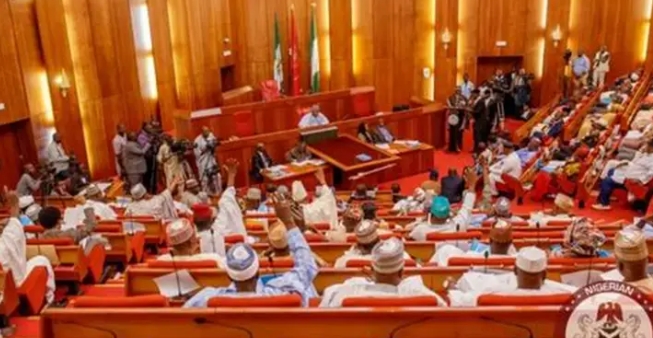
Getting your Trinity Audio player ready…
The Senate on Tuesday again approved electronic transmission of election results, with manual collation retained as a backup, following a tense plenary session in which 15 lawmakers opposed the retention of the controversial proviso in Clause 60 of the Electoral Act (Repeal and Re-Enactment) Bill, 2026.
The decision came after a dramatic division on the floor, with 55 senators voting to retain the manual backup clause, while Senator Enyinnaya Abaribe (ADC/Abia South) and 14 others stood against it.
The upper chamber had initially passed the bill but was forced to rescind its decision and recommit it to the Committee of the Whole after fresh concerns were raised about discrepancies in several clauses and the timing of the 2027 general elections announced by the Independent National Electoral Commission.
Tuesday’s session was dominated by a renewed battle over Clause 60, which deals with the transmission and collation of election results. Proceedings resumed with Abaribe demanding a division on the clause, igniting a rowdy session. The Abia South lawmaker had attempted a similar move during last week’s emergency plenary but withdrew under pressure, drawing public criticism and internal grumblings within the chamber.
Senate Leader Opeyemi Bamidele intervened, urging calm. “Whether or not he has done that in the past, it is within his (Abaribe’s) rights to call for it. Let us allow him,” he said.
Senate President Godswill Akpabio reminded colleagues of Abaribe’s earlier failed attempt. “People were mocking you on social media,” Akpabio said, noting that the previous demand had been withdrawn. Several opposition senators immediately objected, insisting that the matter was properly before the chamber.
Deputy Senate President Barau Jibrin, citing Order 52(6) of the Senate Standing Orders, argued that revisiting any provision already ruled on would be out of order. The submission sparked further uproar, during which Senator Sunday Karimi briefly confronted Abaribe. Bamidele reminded lawmakers that he had formally moved a motion for rescission, meaning prior decisions on the bill were no longer valid. He maintained that Abaribe’s demand for a division was consistent with the rescission motion.
Each time Akpabio raised the issue mockingly, Abaribe and a handful of opposition senators shouted him down, escalating tensions. Eventually, the Senate President put the matter to a vote.
Senators supporting the manual backup proviso added to Clause 60(3) were asked to indicate by raising their hands. Fifty-five lawmakers, including Senate Deputy Minority Leader Senator Lere Oyewunmi, stood in support.
Those opposed—favouring real-time electronic transmission without the manual fallback—were only Abaribe and 14 others. With the majority prevailing, the manual backup remained.
Under the amended clause, the manually completed and signed Form EC8A will serve as the primary basis for collation and declaration of results if electronic transmission is disrupted by network or communication challenges. This ensures that while results are uploaded electronically to INEC’s Result Viewing Portal (IReV), manual documentation at polling units remains legally decisive where technology fails.
Before the division, the Senate had reversed its earlier passage of the bill and recommitted it for fresh consideration. Rising under Order 52(6), Bamidele moved that the Electoral Act (Repeal and Re-Enactment) Bill, 2026, be rescinded and returned to the Committee of the Whole.
He explained that the motion followed INEC’s announcement fixing the 2027 general elections for February 2027. Stakeholders had raised concerns that the date conflicted with the statutory requirement that elections be held at least 360 days before the expiration of tenure, as stipulated in Clause 28 of the bill.
Bamidele also cited concerns that elections during Ramadan could affect voter turnout, logistics, stakeholder participation, and the overall inclusiveness and credibility of the process.
He highlighted discrepancies in the bill’s Long Title and multiple clauses—including Clauses 6, 9, 10, 22, 23, 28, 29, 32, 42, 47, 51, 60, 62, 64, 65, 73, 77, 86, 87, 89, 93, and 143—affecting cross-referencing, numbering, and internal consistency.
The rescission effectively nullified all prior legislative actions on the bill, allowing the Senate to start afresh. Despite clause-by-clause reconsideration, the outcome on electronic transmission remained unchanged.
Following the defeat of the minority bloc, some aggrieved lawmakers walked out of plenary. The renewed approval comes one week after intense public pressure, protests, and criticism from civil society groups, youth movements, and opposition figures, who had accused lawmakers of attempting to weaken electoral safeguards ahead of the 2027 polls.
While electronic transmission was restored, the Senate stopped short of making real-time uploads compulsory. Presiding officers are required to upload polling unit results to IReV after voting and documentation. Where electronic transmission is not possible due to network issues, the manually completed Form EC8A serves as the official basis for collation.
After the division, Akpabio praised both sides. “Let me thank distinguished senators for their patriotism and display of democracy.
“Those in the minority showed courage by standing against the proviso, and those in the majority ensured the primary mode of election results remains the Form EC8A. Elections are won and lost at polling units, not collation centres,” he said.
The Senate President described the electronic transmission system as a landmark innovation, allowing election monitors—including foreign observers—to track results without visiting Nigeria’s more than 176,000 polling units.
Akpabio did not comment on whether the 2027 presidential election date would shift from February 20 to January 13, fueling speculation in political circles.
Meanwhile, protests continued at the National Assembly complex, with demonstrators under the banner of Occupy the National Assembly warning lawmakers against any actions that could undermine the credibility of the 2027 elections.